

Reference / Architecture and modules
AlphaAvatar Host
alpha-avatar-host starts AlphaAvatar, owns shared inference, and supervises Avatar
executions. Interaction connections belong to session backends; Agents, Core and RTC
do not depend on Host. The App is not required to run the service.
📦 Package structure
Startup overview · Package overview
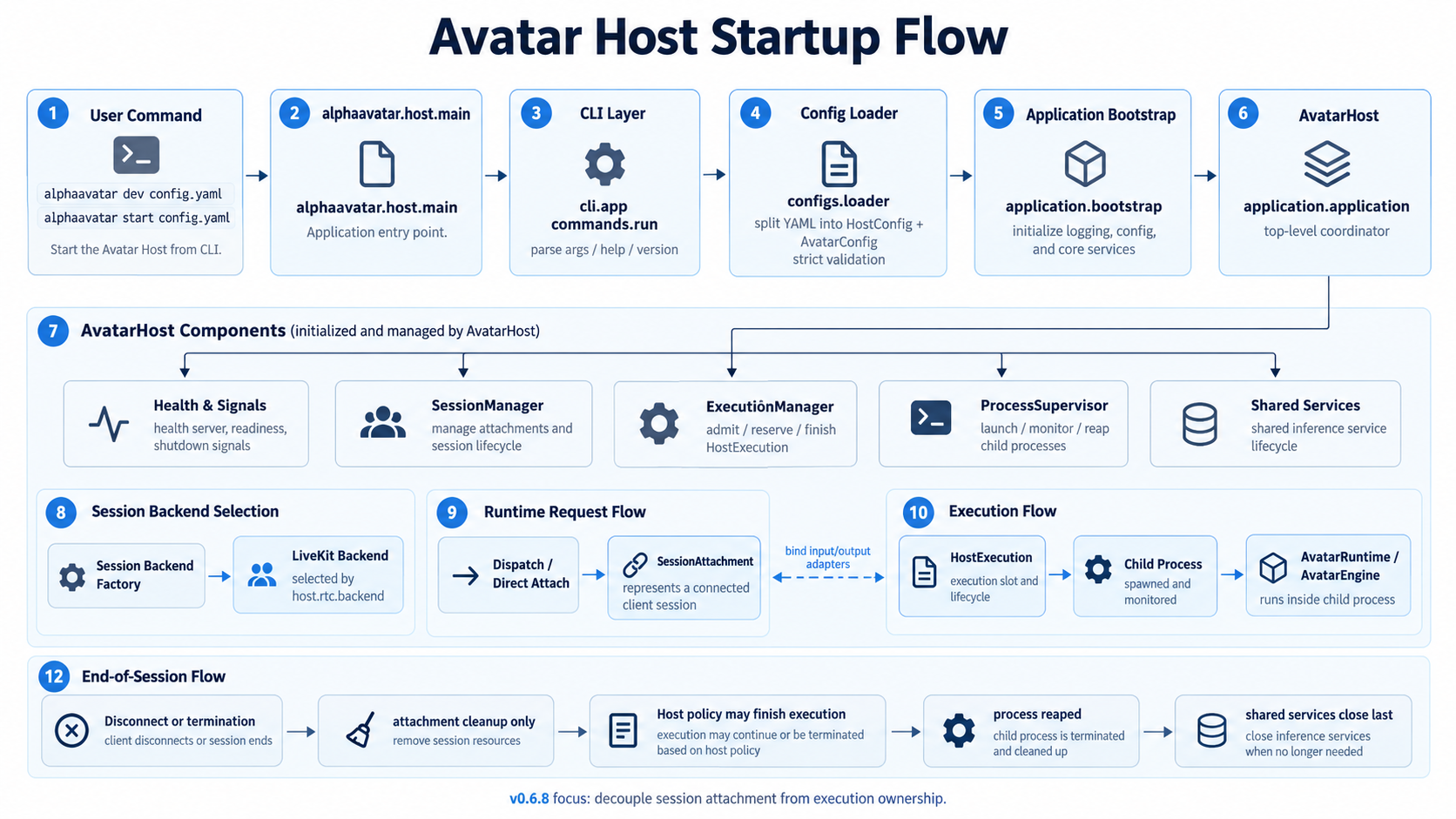
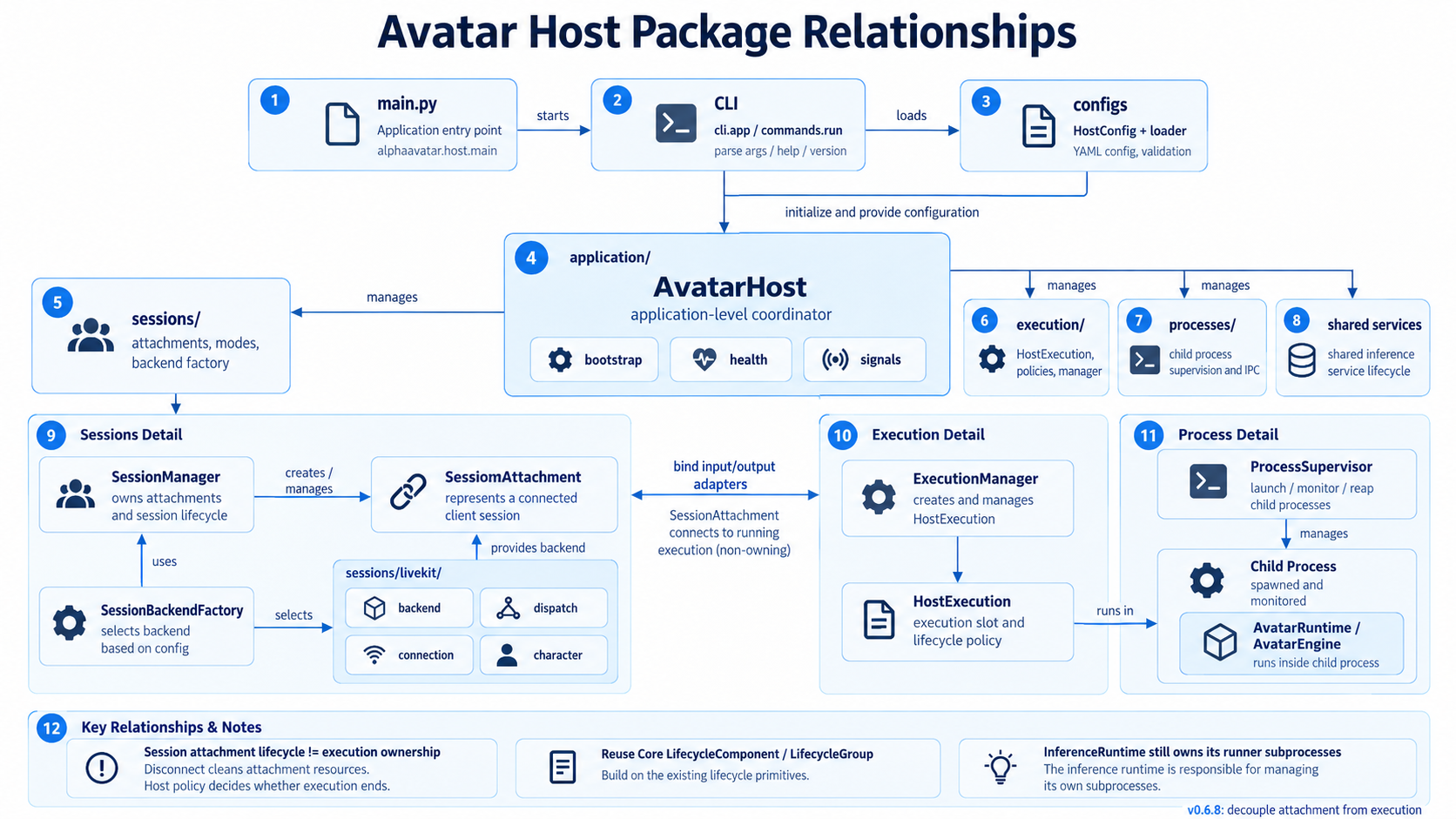
The diagrams are conceptual. Host holds execution handles in the parent process; Engine, Runtime and their session adapters are assembled inside execution children.
Run
Use the repository's Python 3.13 environment and your configured provider credentials:
dev defaults to DEBUG and an available health port; it does not watch or reload code.
start defaults to INFO and port 8081, and reuses a Host host start runs for the same home
(host). Help/version do not start models or require RTC
credentials. Each command takes a bundle name, a YAML/JSON file, or nothing for the default
bundle; configuration overrides use key=value after it.
Create a bundle (with its profiles, and as the default if none is set), and optionally check it without starting anything:
start and dev run the same validation before starting. See docs/cli for
every command and the bundle layout. The Python entry points live in
alphaavatar.host.configs (select_configuration, load_application,
check_application_paths, validate_plugin_settings, create_bundle, read_settings,
describe_summary, describe_application, describe_error, format_failure,
output_scrubber); Doctor's report comes from alphaavatar.host.tools.doctor.diagnose (async),
or prepare and Diagnosis.run to run the static checks first.
Configuration
Keep the existing Avatar settings at the top level and add Host settings beside them:
LiveKit requires LIVEKIT_URL, LIVEKIT_API_KEY and LIVEKIT_API_SECRET. Model and
tool providers need their own credentials. Remote services require TLS.
| Connection mode | Behavior |
|---|---|
dispatch | Registers using avatar.name and waits for matching explicit dispatches. The assignment supplies the room. Host remains available after a session ends. |
direct | Requires room_name, optionally selects device_id, and exits after its single execution ends. It still requires LiveKit. |
The remote participant's session_type metadata selects chat, agent, audio or
video; the default is video. This is independent of connection mode and dev/start.
Logs show time, severity, source location, PID and content. dev previews committed user
input and recorded assistant text; content: off hides those previews and content: all
enables them in both commands. JSONL files are saved under the resolved Avatar workspace's
.logs/host/; conversation text is excluded unless file_content: true. Console capture
and provider traces have separate retention. Review all logs for personal data before sharing.
host.log.events=true with DEBUG enables sampled Core event metadata and gap diagnostics.
These logs preserve source stream identities and sequence numbers; they are not lossless
records or a globally ordered replay log. Do not log raw media or credentials.
Runtime boundaries
Host starts outputs before Engine and inputs. Detaching a session releases its adapters; Host policy decides when its execution ends. Shared inference closes only after execution children settle, and InferenceRuntime remains the sole owner of its runner processes. Ctrl+C/SIGTERM request orderly shutdown; repeated Ctrl+C does not abandon cleanup.
Audio sessions use playback-driven captions through TranscriptSynchronizationProcessor.
PCM streams at the provider's native pace; caption publication and network sending do not
pace audio capture. PCM-only providers use estimated word timing, corrected by measured
audio duration. LiveKit playback feedback measures the local audio queue, not remote speakers.
The health check paths are /live, /ready and /status. They are unauthenticated and bind
to 127.0.0.1 by default; set host.health.bind explicitly only behind network controls.
/status reports readiness, runner startup states and recent execution ids and codes; it
returns no configuration or credentials.
Execution supervision requires POSIX. Process groups are not complete descendant sandboxes;
deployments that need containment of detached browsers require an external cgroup/container.
One attachment per execution is supported. Reattachment, persistent execution recovery and
sleep/wake are not implemented. Control loss finishes affected jobs before re-registration;
it does not replay model or tool work. Disconnecting does not delete the room.
More information
Deployment · Development · Avatar workspace · Model cache · Character setup
Edits target dev/v0.7.0. Published snapshots do not change.